
|
|
|
University Of California - Los Angeles USA (<http://www.ucla.edu/>) Date: Posted 5/27/2002 |
|
Brown Dwarfs |
|
|
|
he discovery will give scientists better tools for interpreting atmospheres and weather on brown dwarfs or on planets around other stars. “The best analogy to what we witness on these objects are the storm patterns on Jupiter,” said Adam Burgasser, astronomer at UCLA and lead author of the study. “But I suspect the weather
on these more massive brown dwarfs makes the Great Red Spot look like a
small squall.”
Jupiter’s Great Red Spot is a massive storm more than 15,000 miles across and with winds of up to 270 miles per hour. Burgasser teamed with planetary scientist Mark Marley, meteorologist Andrew Ackerman of NASA Ames Research Center in California’s Silicon Valley, and other collaborators to propose how weather phenomena could account for puzzling observations of brown dwarfs. |
|
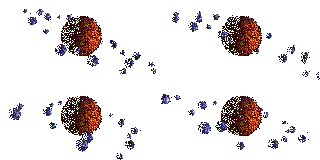
The team calculated that using a model with breaks or holes in the cloudy atmosphere solved the mysterious observations of cooling brown dwarfs. Brown dwarfs, only recently observed members of the skies, are “failed stars at best,” Ackerman said. Not massive enough to sustain the burning of hydrogen, like stars, brown dwarfs go through cooling stages that scientists observe with infrared energy-detecting telescopes. They appear as a faint glow, like an ember from a fire that gives off both heat and light energy as it dims. Astronomers expected brown dwarfs, like most objects in the universe, to grow steadily fainter as they cool. However, new observations showed that during a relatively short phase, brown dwarfs appear to get brighter as they cool. The explanation lies in the clouds. At least 25,000 times fainter than the sun, brown dwarfs are still incredibly hot, with temperatures as high as 3,140 degrees Fahrenheit (2,000 degrees Kelvin). At such high temperatures, substances such as iron and sand are in gaseous form. As brown dwarfs cool, these gases condense in the atmosphere into liquid droplets to form clouds, similar to water clouds on Earth. |
|
“The model developed by the group for the first time matches the characteristics of a very broad range of brown dwarfs, but only if cloud clearing is considered,” Burgasser said. “While many groups have hinted that cloud structures and weather phenomena should be present, we believe we have actually shown that weather is present and can be quite dramatic.” By using Earth’s weather as a starting point, Ackerman helped the team work the storms - including wind, downdrafts and iron rain - into their calculations. “The astrophysicists needed some help understanding rain because it’s not an important process in most stars,” Ackerman said. “We used observations and simulations of terrestrial clouds to estimate the effect of iron rain on the thickness of an iron cloud.” The study will help researchers determine the makeup of atmospheres outside our solar system. |
|
Brown dwarfs serve as a training ground for scientists to learn how to interpret observations of planet-like objects around other stars, Marley said. “Everybody wants to find brown dwarfs that are even colder and have water clouds just like Earth. Once we find those, that will be a good test of our understanding.” ### NASA, the National Science
Foundation and the Hubble Postdoctoral Fellowship funded this study, and
supplied much of the data.
More information about
this study is available at: http://www.journals.uchicago.edu/ApJ/journal/
|
|
The original news release can be found at <http://www.ucla.edu/Templates/ NewsItem1.html> |
|
"University Of California - Los Angeles USA" |
|
SCIENCE DAILY .COM |
|
|
