
|
|
|
Space Telescope Science Institute (<http://www.stsci.edu>) Contact: Cheryl Gundy , Media Coordinator/public Information Officer Phone: USA (410) 338-4707; Email: gundy@stsci.edu Date: Posted 1/18/2000 |
|
|
|
The "clapper" is the gravitational wallop of a star that passed near Beta Pictoris some 100,000 years ago. |
|
Similar fly-bys of our solar system long ago may have reshuffled the comets that now populate our Oort cloud and Kuiper belt. Discovered in 1983, the dust
disk around the nearby star Beta Pictoris -- long suspected to harbor a
planetary system -- has puzzled astronomers because it contains more dust
grains than any other comparable system.
Yet, one side of the disk is 20 percent longer and thinner than the other side. |
|
Hidden within the densest part of the disk are clumps of dust that are present only on the long, thin side of the disk. Because the disk is tilted edge-on to our line-of-sight, the astronomers inferred that the clumps might represent rings if the disk was viewed face-on. They hypothesized that these rings must be highly elliptical if they appear only on one side of the disk, and this could arise if another massive object, like a passing star, recently disturbed the entire system. |
|
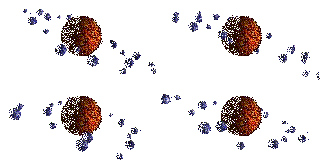
The simulation explored what would happen if another star zipped by it in a near-collision trajectory. In the simulation, the gravity of the passing star rearranged the orbit of each particle, setting up an elliptical ring system 100,000 years after the almost catastrophic event. The model also reproduced the 20 percent asymmetry in the disk, which has mystified astronomers since the Beta Pictoris disk was first seen 16 years ago. |
|
Their simulations predict it might be only a fraction of the mass of our Sun (a class called an M-dwarf star). The present results will be published in a future issue of Astrophysical Journal Letters. The Hubble research team, led by Paul Kalas (Space Telescope Science Institute, Baltimore, Md.), consists of John Larwood (Queen Mary and Westfield College, London, United Kingdom), Bradford Smith (University of Hawaii, Honolulu, Hawaii), and Alfred Schultz (Space Telescope Science Institute). |
|
The Hubble Space Telescope is a project of international cooperation between NASA and the European Space Agency. |
|
|
|
Space Telescope Science Institute USA |
|
SCIENCE DAILY .COM |
|
|
