
|
|
|
NASA/Marshall Space Flight Center (<http://www.msfc.nasa.gov>) Date: Posted 9/14/2001 |
|
|
|
|
|
John Arabadjis and Mark Bautz of the Massachusetts Institute of Technology in Cambridge, Mass., and Gordon Garmire of Penn State University in University Park, announced their results today at the "Two Years of Science with Chandra" symposium in Washington, D.C. Their observations enabled them to trace the distribution of dark matter the galaxy cluster EMSS 1358+6245. |
|
"When combined with data from the Hubble Space Telescope, we are able to place restrictions on the cross section, or size, of the dark matter particles,'' said Arabadjis. "The larger the particles, the more strongly they interact, and the more they alter the dark matter distribution." In galaxy clusters, the amount of dark matter can be inferred by measuring the pressure in the X-ray emitting hot gas and determining how much dark matter is required to provide the gravity necessary to keep the gas from escaping the cluster. In the cluster EMSS 1358+6245, the mass of the dark matter is found to be about 4 times that of the "normal" matter (matter not comprised of exotic particles), typical of large galaxy clusters. The distribution of dark matter holds the key to understanding its composition. |
|
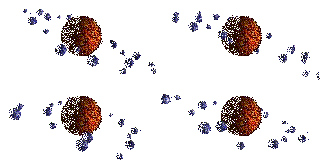
Recent optical observations of galaxies and galaxy clusters have suggested that dark matter particles may interact more vigorously than simple cold dark matter. The problem is that galaxies composed primarily of cold dark matter should have a greater central concentration of dark matter than the optical data suggest. One solution has been to introduce self-interacting dark matter, or SIDM. By comparing the Chandra data with theoretical simulations, scientists can place strict constraints on the SIDM particles. Chandra observations show
there is no evidence for an excessively spread-out dark matter distribution
at distances larger than 150,000 light years from the cluster's center.
Inside that distance the dark matter may rather uniformly distributed,
so some collisions between dark matter particles may still be needed.
EMSS 1358+6245, about 4 billion light years away in the constellation Draco, was observed by Chandra for 15.3 hours on Sept. 3-4, 2000 using the ACIS detector. |
|
The Smithsonian's Chandra X-ray Center controls science and flight operations from Cambridge, Mass. Images associated with
this release are available
|
|
The original news release can be found at <http://www1.msfc.nasa.gov/NEWSROOM/ news/releases/2001/01-298.html> |
|
"NASA/Marshall Space Flight Center USA" |
|
SCIENCE DAILY .COM |
|
|
