
|
|
|
Space Telescope Science Institute (<http://www.stsci.edu>) Date: Posted 11/29/2001 |
|
|
|
|
|
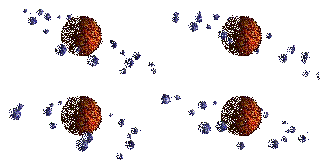
The planet orbits a yellow, Sun-like star called HD 209458, a seventh magnitude star (visible in an amateur telescope), which lies 150 light-years away in the autumn constellation Pegasus. Its atmospheric composition was probed when the planet passed in front of its parent star, allowing astronomers for the first time ever to see light from the star filtered through the planet's atmosphere. |
|
"This opens up an exciting new phase of extrasolar planet exploration, where we can begin to compare and contrast the atmospheres of planets around other stars," says Charbonneau. |
|
The Hubble observation was not tuned to look for gases expected in a life-sustaining atmosphere (which is improbable for a planet as hot as the one observed). Nevertheless, this unique observing technique opens a new phase in the exploration of extrasolar planets, say astronomers. Such observations could potentially provide the first direct evidence for life beyond Earth by measuring unusual abundances of atmospheric gases caused by the presence of living organisms. |
|
Based on that observation the planet is estimated to be 70 percent the mass of the giant planet Jupiter (or 220 times more massive than Earth). Subsequently, astronomers discovered the planet passes in front of the star, causing the star to dim very slightly for the transit's duration. This means the planet's orbit
happens to be tilted edge-on to our line-of-sight from Earth.
The planet is an ideal target for repeat observations because it transits the star every 3.5 days - which is the extremely short amount of time it takes the planet to whirl around the star at a distance of merely 4 million miles from the star's searing surface. This precariously close proximity to the star heats the planet's atmosphere to a torrid 2000 degrees Fahrenheit (1100 degrees Celsius). |
|
These earlier observations thus established that the planet is a gas giant, like Jupiter and Saturn. The planet's swift orbit allowed for observations of four separate transits to be made by Hubble in search of direct evidence of an atmosphere. During each transit a small
fraction of the star's light passed through the planet's atmosphere on
its way to Earth.
Though the star also has sodium in its outer layers, the STIS precisely measured the added influence of sodium in the planet's atmosphere. |
|
They hope eventually to detect methane, water vapor, potassium and other chemicals in the planet's atmosphere. Once other transiting giants are found in the next few years, the team expects to characterize chemical differences among the atmospheres of these planets. |
|
They are the size of Jupiter
but orbit closer to their stars than the tiny innermost planet Mercury
in our solar system.
Conventional theory is that these giant planets could not have been born so close to their stars. Gravitational interactions with other planetary bodies or gravitational forces in a circumstellar disk must have carried these giants via spiraling orbits precariously close to their stars from their birthplace farther out, where they bulked up on gas and dust as they formed. |
|
The chances for detection will be more challenging, since detecting a planet orbiting at an Earth-like distance will mean a much tighter orbital alignment is needed for a transit. And the transits would be much less frequent for planets with an orbital period of a year, rather than days. Eventually, study of the atmosphere of these Earth-like planets will require meticulous measurements by future larger space telescopes. |
|
The Hubble Space Telescope is a project of international co-operation between NASA and the European Space Agency (ESA). The National Center for Atmospheric Research's primary sponsor is the National Science Foundation. |
|
The original news release can be found at: <http://oposite.stsci.edu/pubinfo/PR/ 2001/38/pr.html> |
|
Space Telescope Science Institute USA |
|
SCIENCE DAILY.COM |
|
|
