
|
|
|
|
|
|
|
|
|
A team led by Leisa Townsley, a senior research associate in astronomy and astrophysics at Penn State University, uncovered this wind phenomenon in the Rosette Nebula, a stellar nursery. With the Chandra X-ray Observatory, the team found that the most massive stars in the nebula produce winds that slam into each other, create violent shocks, and infuse the region with 6-million-degree gas. The findings are presented in Washington, D.C., today at a conference entitled "Two Years of Science with Chandra." |
|
"We now have a new view of the engine lighting the beautiful Rosette Nebula and new evidence for how the interstellar medium may be energized." Townsley and her colleagues
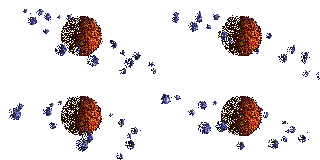
created a striking X-ray panorama of the Rosette Molecular Cloud from four
images with Chandra's Advanced CCD Imaging Spectrometer.
In one corner of the Rosette Molecular Cloud lies the Rosette Nebula, called an "H II region" because the hydrogen gas there has been stripped of its electrons due to the strong ultraviolet radiation from its young stars. This region, about 5,000 light years away in the constellation Monoceros, the Unicorn, has long been a favorite among amateur astronomers. The wispy, colorful display is visible with small telescopes. |
|
Fueling the fury are a handful of massive type-O and type-B stars at the core of the nebula, the most massive members of a populous "OB association" that also includes hundreds of lower-mass stars. "Until this observation, no one really knew where the energy of the powerful OB stellar winds goes," said Eric Feigelson, professor of astronomy and astrophysics at Penn State and a co-investigator in the study. "Theorists have speculated about this for decades, and we now see with Chandra the heat from the winds slamming into the cooler gas." |
|
Chandra imaged over 300 individual young stars in the Rosette Nebula, plus hundreds more in the Rosette Molecular Cloud. "We were able to identify the faint, diffuse radiation by subtracting out these point sources and looking at what was left over," explains team member Patrick Broos, a research assistant in astronomy and astrophysics at Penn State. |
|
Rather, the diffuse emission
must be related to the way the stellar winds from OB associations dissipate
their energy.
Chu and Montmerle have joined the research team to help interpret the Chandra results. |
|
|
|
|
|
Penn State University USA |
|
SCIENCE DAILY .COM |
|
|
